

Mastering the Art of Granite Countertop Polishing: A Technical Guide for Fabricators and DIY Enthusiasts. Understanding the Basics, Essential Tools, Grit Sequences, RPM Settings, and Common Pitfalls
Polishing granite countertops is both a science and an art. While the glossy, mirror-like finish of a high-end granite slab appears effortless, achieving it requires a precise understanding of abrasive technology, machinery, and material behavior. Whether you are a professional stone fabricator or a hands-on homeowner, mastering the fundamentals of granite polishing ensures a durable, high-clarity finish without damaging the stone.
This guide breaks down the essential components of granite polishing—from the basic principles to the critical “do-nots” that can ruin a project.
1. Granite Polishing Basics: Why It’s Different from Marble
Before picking up a tool, it is crucial to understand the basic nature of granite. Unlike marble, which is a calcium-based carbonate stone that reacts to acid, granite is a hard, silicate-based igneous rock composed primarily of quartz and feldspar.
The core principle of granite polishing is physical abrasion. You are not “painting” a shine onto the stone; you are mechanically grinding the surface with progressively finer diamond abrasives until the surface becomes so smooth that it reflects light like a mirror. This process is followed by a chemical reaction if using crystallization compounds, but the foundation remains the grinding sequence.
Furthermore, hardness matters. Because granite is extremely hard, it requires “soft bond” polishing pads. This is a counterintuitive but critical “basic” rule: hard stones need soft-bonded tools (so the diamonds can release and expose fresh cutting edges), while soft stones (like marble) require hard-bonded tools.
2. Required Tools: The Essential Kit for Granite
To achieve a professional finish, you cannot rely on general-purpose sanders or household sponges. The “Required Tool” list for granite polishing is specific and non-negotiable:
-Variable-Speed Angle Grinder/Polisher: A standard grinder runs at 10,000+ RPM—which is too fast for granite. You need a variable-speed machine (ideally 1,000 to 5,500 RPM) to control heat generation.
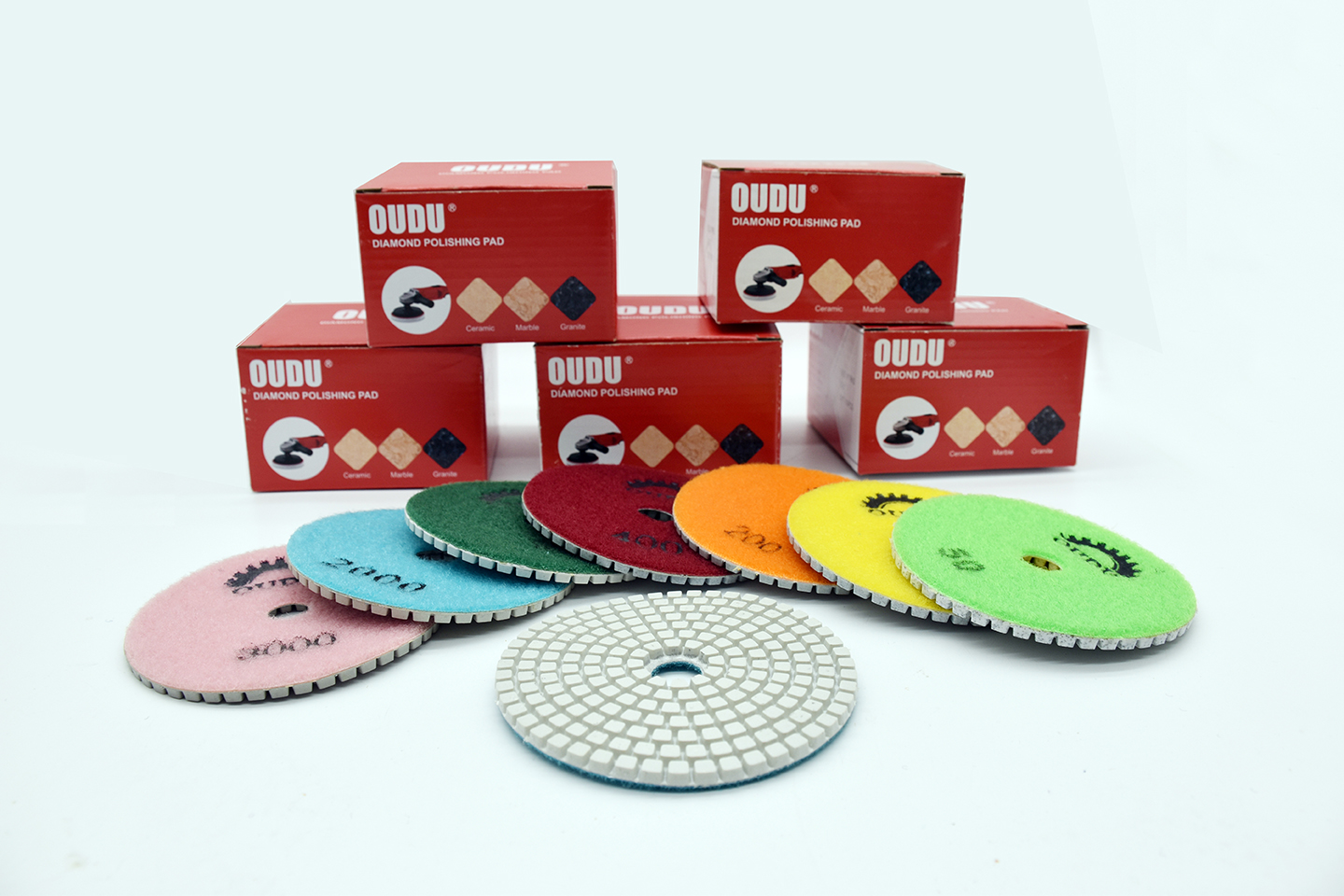
- Diamond Resin Polishing Pads: Specifically designed for granite (often labeled for quartz/granite). You have a choice between Wet Pads (better cooling, longer life) and Dry Pads (more convenient for on-site edge work with dust extraction).
- Water Supply (for Wet Polishing): A simple spray bottle or a water feed system to cool the pads and suppress dust.
- Backing Pad: A rubber/plastic pad with Velcro attachment to mount the polishing discs onto the grinder.
- Sealer: A penetrating silicone/water-based impregnator to seal the open pores after polishing.
- Safety Gear: N95 respirator (silica dust is hazardous) and safety goggles.
3. The Grit Sequence: The Unskippable Order of Operations
The “Grit Sequence” is the roadmap to a perfect shine. Skipping grits is the number one cause of “hazy” or “scratched” granite.
The sequence must progress in a strict step-by-step escalation from coarse to fine. A standard granite sequence uses the following resin-bonded diamond grits:
- 50–100 Grit (Coarse Grinding): Removes deep scratches, lippage (uneven seams), and heavy tool marks. This stage creates a matte, flat surface.
- 200–400 Grit (Medium Grinding): Refines the surface, erasing the scratches left by the coarse grit.
- 800–1000 Grit (Fine Grinding): Prepares the surface for polishing. The stone will look smooth but cloudy.
- 2000–3000 Grit (High-Polish): The “shine” stage. At 3000 grit, the surface becomes highly reflective.
- Buffing (Optional): Some use a final 5000/8000 grit pad or crystallizing powder to enhance the “wet look” and deepen the color.
Critical rule: Do not jump from 50 grit to 300 grit. The 300-grit pad is too fine to remove the deep “scratches” left by the 50-grit pad. This results in “false shine”—a surface that reflects light but looks like a spiderweb of hairline scratches when viewed closely.
4. RPM Recommendation: Speed Control is Everything
Regarding RPM (Revolutions Per Minute) , there is no single universal number. The speed must correspond to the grit size and the condition of the surface. Using the wrong RPM leads to overheating (burn marks) or ineffective polishing.
- Coarse Grinding (50–200 Grit): Keep the speed low, around 1,500 – 2,500 RPM. This provides high torque to cut the stone without creating excessive friction heat.
- Fine Grinding (400–1000 Grit):Increase speed to 2,500 – 3,500 RPM.
- Polishing (2000–3000 Grit): To create friction heat for the resin bond to work and produce a gloss, raise the speed to 4,000 – 5,500 RPM.
- Safety Limit:Never exceed 6,000 RPMwith resin pads. Higher speeds can melt the resin bond, causing the pad to “burn” the granite surface, leaving yellow scorch marks that are often impossible to remove without re-grinding.
Pro Tip: Always keep the tool moving. Staying stationary at any RPM creates localized heat, which leads to “halo” or “burn” marks.
5. Common Mistakes: What Not to Do
Even with the right tools, beginners make consistent errors. Here are the most frequent pitfalls:
1. Skipping the Grit Sequence (The “Shortcut” Fallacy): As mentioned, trying to jump from 150 to 3000 grit to save time results in a cloudy, scratched mess. You cannot cheat the physics of abrasion.
2. Excessive Pressure: Pressing down hard on the grinder does not make it cut faster; it slows down the rotation and causes the backing plate to warp. Let the diamond grit do the work. Use just the weight of the machine (1–2 kg of pressure).
3. Dry Polishing Without Dust Control:If using dry pads, failing to connect a vacuum to the guard fills the air with dangerous crystalline silica. Worse, it causes rapid overheating.
4. Ignoring the Sealer: Many people polish the surface perfectly but forget to apply a penetrating sealer afterward. Polishing opens the stone’s pores; if you don’t seal it, the first splash of coffee or red wine will stain the freshly polished surface permanently.
5. Incorrect RPM for the Stage: Using 5000 RPM on a 50-grit pad generates massive heat, instantly burning the resin on the pad and scorching the granite. Conversely, using 1500 RPM on a 3000-grit pad won’t generate enough friction to create the chemical “gloss” effect.
Conclusion
Polishing granite countertops is a methodical process that demands respect for the material’s hardness. By following the correct “basics” (using soft-bond tools for hard stone), gathering the correct tools(variable speed polisher and water/dust control), strictly adhering to the grit sequence (never skipping numbers), respecting the RPM recommendation (low for cutting, high for shining), and avoiding common mistakes (especially pressure and sealing), you can achieve a factory-quality, mirror finish.
FAQ
Q: After polishing, it looks very shiny, but why does it have a hazy white film when dried?
A:This is because you didn’t polish long enough with the final grit (3000 grit), or the RPM didn’t reach above 4,000. You’ve only achieved an “oily shine” rather than a true crystallized gloss. You need to go back to 1000 grit and redo the entire sequence.
Q: What should I do if I accidentally burn the countertop and leave yellow scorch marks?
A:For mild burns, you can remove them by re‑grinding with a 50‑grit coarse pad and plenty of water. For severe burns that have penetrated deep into the stone, you will need to call a professional to use special chemical agents to restore it – or you may have to accept the damage and live with it.
Q: I don’t have a professional polisher; can I use a car waxing sponge pad instead?
A:Absolutely not. The RPM and force are completely insufficient. It will only spread wax evenly and won’t repair any scratches at all. It’s a classic case of self‑deception – you’re just fooling yourself.
Looking for Professional Diamond Tool Solutions?
Choosing the correct tool specifications and operating parameters is essential for achieving optimal processing performance. For high-quality diamond polishing pads and professional technical support, contact Quanzhou Tianli Grinding Tools Co., Ltd.—providing professional diamond tools for granite, quartz, marble, and concrete processing industries.
Post time: Jun-27-2026


